- JEPAA Member
- Novel
- Masahiko Matsuo
- 小説
- 松尾政彦
© 2026 Masahiko Matsuo.
SCROLL
MEDITERRANEAN CONFERENCE CENTER
July 3–5, 2026
Masahiko Matsuo
松尾政彦
Masahiko Matsuo is a Japanese writer and a member of the Japan-Europe Palace Art Association.
His works have been exhibited not only in Japan, but also in countries around the world.
松尾政彦は日本の作家。日欧宮殿芸術協会の会員。 日本のみならず世界各国に作品を出展。
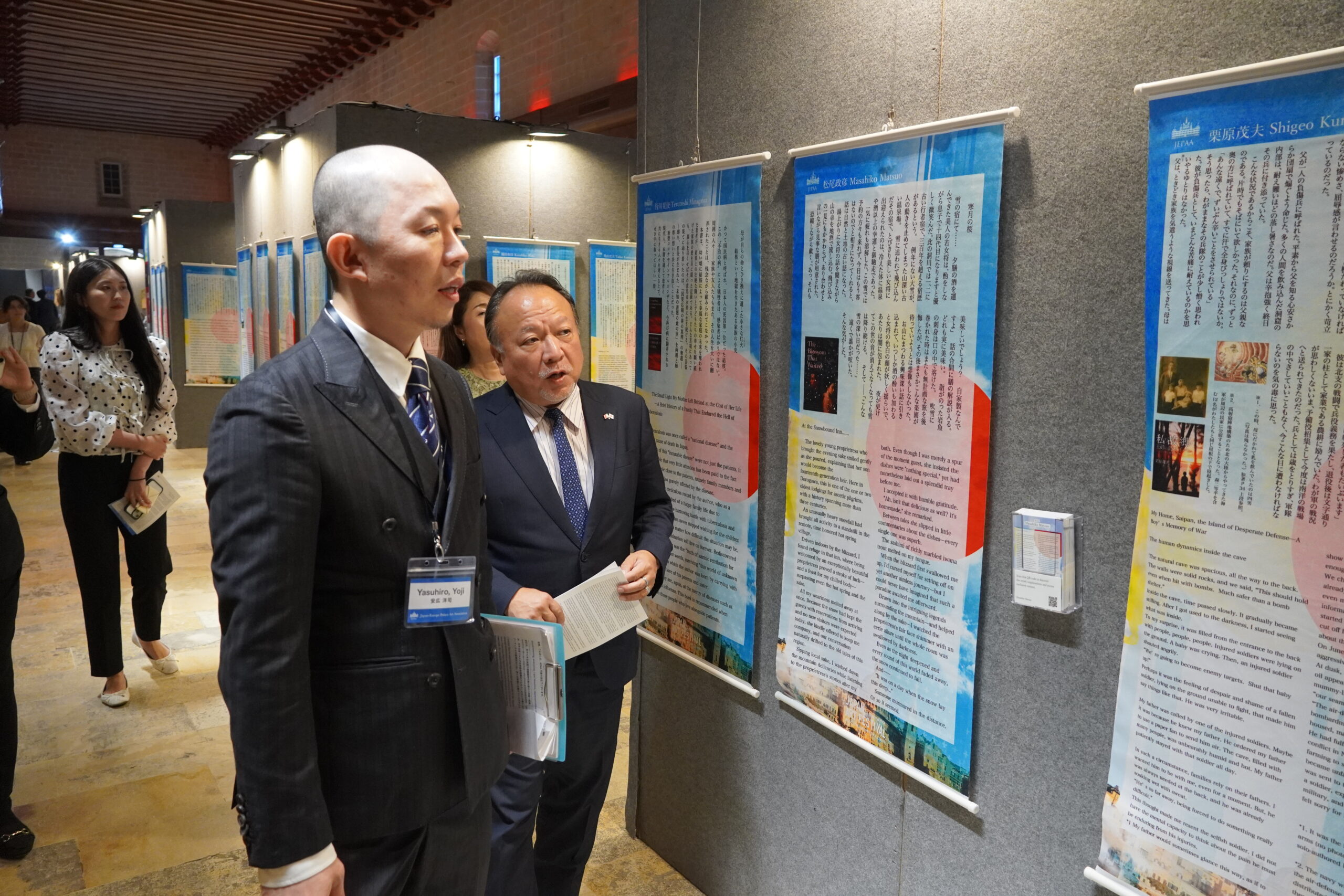
At the snowbound Inn…
寒月の桜

Artist’s Statement
Humanity, having crossed the vast continent, finally reached its eastern edge and stood before an immense sea. There, amid the changing seasons, they found a land blessed with abundant waters and the gifts of the mountains and oceans. It was a place so rich and harmonious that neither words nor written language seemed necessary, and it was there that history began.
The people, who lived without conflict, offered gratitude and prayers to all aspects of the natural world surrounding them — the sun and moon, the sea, the mountains, the water, the trees, the rocks, and the wind. In seeking to respond to these sacred forces, they learned to discipline and refine themselves. Nature itself became an object of reverence and awe, and thus, since ancient times, these countless spiritual presences have been known as the “Eight Million Gods,” a belief that continues to this day.
In order to purify both body and spirit, people entered the mountains — some close at hand, others severe and remote — to undertake spiritual training. For the Japanese people, the divine has always resided within the great forces of nature.
It is said that En no Gyōja, regarded as the founder of mountain ascetic practice, attained enlightenment as a Great Gongen after enduring harsh spiritual austerities in the mountains of Kii. The land connected to this legend still treasures its cherry trees as sacred objects, and during the flowering season, many people gather there.
This is a sorrowful yet beautiful Japanese story, born from such a sacred place, about a pure-hearted man and woman.
The practice of Yamabushi ascetic training continues unbroken even today.
大陸を踏破した人類は、その東端に辿り着き眼前に広大な海を見る。そこは四季が巡り豊かな水と海山の幸に溢れていた。言葉も文字も必要の無い程の地に歴史が始まった。
争う事の無い人々は、取り巻く自然の全て、太陽や月、海に、山に、水に、木に、岩に、風あらゆるモノに感謝し、祈り又それらに応える為に鍛える事を覚えた。それらは又畏敬対象であり
故に古来より「やおろずの神」と称され今日に続く。身や心を清らかに鍛える為に人々は身近なあるいはより険しい山々に入るようになる。日本人にとっての「神」は大自然に宿るモノであった。
山岳修行の祖と言われる役小角が紀伊の山で苦行の末、大権現を悟ったと伝わる、この物語の地は、現在も桜の木が御神木として大切にされ、華の時季には多くの人々が集まる。
そんな地で一生まれた清らかな男女の悲しくも美しい日本のお話です。
山伏修行は綿々と今も続いています。
Message from the Artist
Japanese people are often misunderstood as being either nonreligious or merely polytheistic. Yet at our core, we are a people who revere nature, treat others with kindness, and hold ourselves to strict discipline.
Even now, we aspire to remain that way. Though the current state of the world places us in difficult circumstances, we continue to hope for a world that is peaceful, gentle, and harmonious.
日本人を無宗教や多神教と勘違いされますが、日本人は元来自然を敬い、人に優しく自分に厳しい民族です。
今もそうありたいと思っています。現在の世界情勢の中では苦しい立場ですが、いつも穏やかで、優しく、仲良く願っています。
Japan-Europe Palace Art Association Commentary
The true strength of Kangetsu no Sakura lies not merely in its portrayal of tragic love, but in the way it quietly evokes the very spiritual landscape of Japan itself. Beginning with the chapter At the Snowbound Inn…, set deep within the mountains of Dorogawa, the novel carries both a profound sense of journey and an almost dreamlike atmosphere, gently drawing the reader into another world. In particular, the silence of the storm-covered mountains, the graceful demeanor of the beautiful young proprietress, and the descriptions of local sake and mountain cuisine are rendered with such delicacy that one can almost feel their warmth and scent, not merely picture them visually. Nature here is never treated as a simple backdrop; rather, it envelops human destiny, prayer, and emotion, resonating deeply with the ancient Japanese notion of the “Yaoyorozu no Kami” — the belief that divinity resides within all things in nature.
Moreover, the novel possesses a dignity that prevents its “unfulfilled love” from becoming mere sentimental tragedy. The lovers, torn apart by class differences and fate, illuminate the beauty and nobility of loving another person with unwavering sincerity — something modern society has gradually begun to forget. Matsuo’s prose never indulges excessively in emotion; instead, like a snowy landscape, it maintains a profound stillness that leaves a lingering resonance in the reader’s heart. For this reason, the work transcends the boundaries of historical fiction, becoming a richly atmospheric literary piece that speaks equally to modern loneliness and to the essential nature of love itself.
『寒月の桜』の魅力は、単なる悲恋小説に留まらず、日本人の精神風土そのものを静かに描き出している点にある。
雪深い洞川の宿で始まる導入部は、旅情と幻想性を帯びながら、読者をゆるやかに異界へ誘う。とりわけ、吹雪に閉ざされた山中の静寂、美しい若女将の柔らかな所作、地酒と山の幸の描写には、視覚だけでなく温度や匂いまでも感じさせる繊細な筆致が宿っている。作者は自然を単なる背景として扱わず、人の運命や祈りを包み込む存在として描いており、その感覚は日本古来の「やおろずの神」の思想とも深く響き合う。
また本作には、“叶わぬ恋”を単なる悲劇として消費しない品格がある。身分差や宿命に引き裂かれる男女の姿は、現代人が忘れかけた「誰かを深く想い抜く精神」の尊さを浮かび上がらせるのである。作者の語りは過度に感情へ流れず、むしろ雪景色のような静けさを保ちながら読者の胸に余韻を残す。そのため本作は、時代小説でありながら現代人の孤独や愛の本質にも触れる、極めて情緒豊かな文学作品として成立している。
Post-Exhibition Report
展覧会開催報告



Exhibition Report URL
展覧会報告URL