- JEPAA Member
- Tanka
- Akira Hongo
- 短歌
- 本郷亮
© 2026 Akira Hongo.
SCROLL
MEDITERRANEAN CONFERENCE CENTER
July 3–5, 2026
Akira Hongo
本郷亮
Akira Hongo is a Japanese poet and a member of the Japan-Europe Palace Art Association.
He exhibits her works in Japan and internationally.
本郷亮は日本の歌人。日欧宮殿芸術協会の会員。
日本のみならず世界各国に作品を出展。

Japan-Europe Palace Art Association Commentary
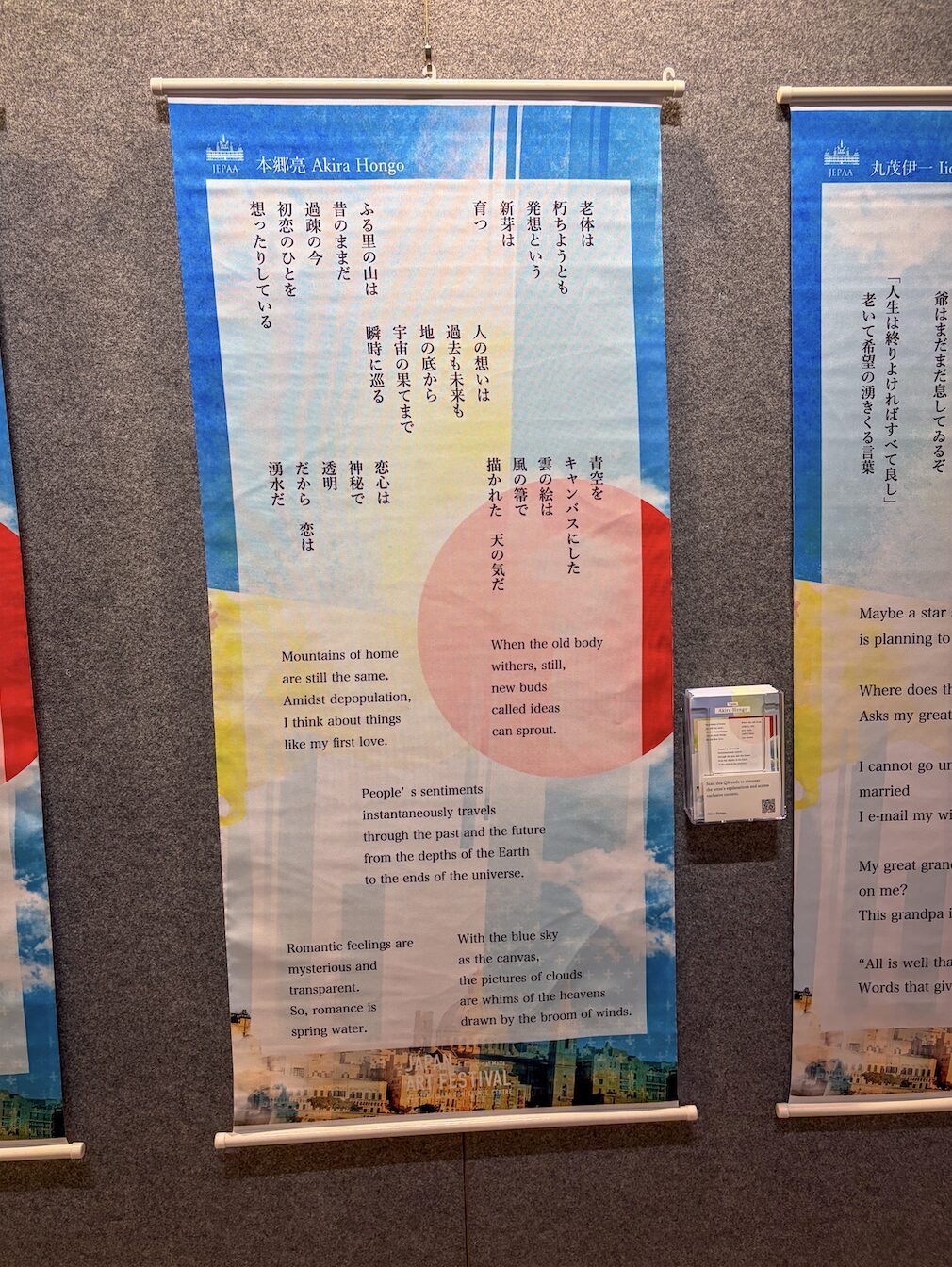
Hongo Akira’s gogyōka poetry possesses a distinctive ability to transform the quiet impressions of everyday life and the accumulated weight of lived experience directly into lyric expression, without relying on excessive ornamentation. In these poems, themes as varied as aging, homeland, love, and the cosmos are connected through deceptively simple language, and within that breadth one senses the author’s deeply personal philosophy of life. Even while confronting the realities of an aging body, the image of “new buds of imagination continuing to grow” reveals not resignation, but a profound faith in the enduring vitality of the human spirit.
Another defining quality of the work lies in its treatment of nature. The sensibility that perceives clouds as paintings drawn across the sky “with the broom of the wind,” or love as a “spring of pure water,” reflects a poetic consciousness that refuses to see the world as fixed or static. Instead, existence is perceived as something perpetually unfolding and renewing itself. Through these brief compositions, readers become aware not only of memory and the passage of time, but also of the subtle interconnectedness between humanity and the natural world.
Although written within the concise form of gogyōka, these works contain both the maturity of a life fully lived and a remarkably fresh sensitivity. Rather than explaining through excess language, the poems expand through suggestion and resonance. It is within this spaciousness of implication that the quiet strength of Hongo Akira’s poetry truly resides.
本郷亮の五行歌には、日常の感慨や人生の実感を、過度な装飾へ流れることなく、そのまま詩情へ転化してゆく独特の魅力がある。
とりわけ本作では、「老い」「故郷」「恋」「宇宙」といった異なる主題が、一見素朴な言葉によって自然に接続されており、その広がりの中に作者自身の人生観が滲み出ている。
老いゆく身体を見つめながらも、「発想という新芽は育つ」と捉える視線には、単なる感傷ではない、人間精神への信頼が感じられる。
また、自然描写の扱いにも本作の個性がある。
雲を「風の箒」で描かれた絵と見る感性や、恋心を「湧水」として表現する透明な比喩には、物事を固定的に捉えず、世界を絶えず生成するものとして見つめる柔軟な詩的感覚が宿っている。
そのため読者は、短い言葉の中に、時間の流れや記憶、人と自然とのつながりまでも感じ取ることになるのである。
五行歌という簡潔な形式でありながら、本作には人生の円熟と瑞々しい感性が共存している。
言葉を重ねることで説明するのではなく、余白によって世界を広げてゆく点に、この作品の静かな力がある。
Post-Exhibition Report
展覧会開催報告

-

- Screenshot

Exhibition Report URL
展覧会報告URL